
What Is Mathematics? A Long-Overdue Clarification
Mathematics is many things… just not the art of calculation

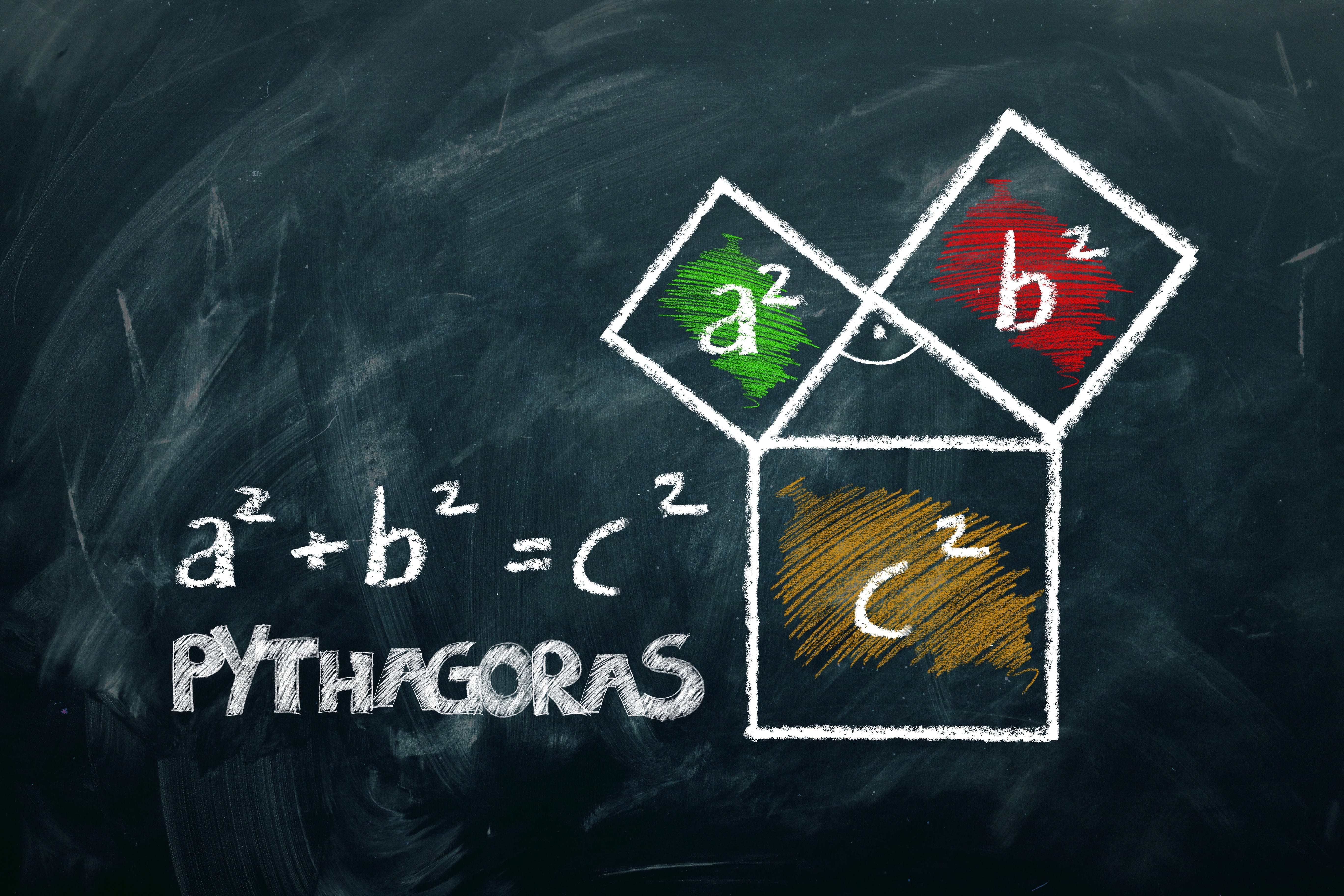
The image most people have of mathematics was usually shaped in school. This image is almost always wrong because the school subject of mathematics does not reflect what mathematics actually is. I am a mathematician, and I will shed some light on the matter below.
There are people who are very good at mental arithmetic. Some can multiply large numbers in their minds faster than it takes someone else to type them into a calculator. That’s impressive, but it has nothing to do with mathematics. A mental arithmetic artist is not a mathematician!
“Nothing reveals a lack of mathematical education more strikingly than excessive precision in numerical calculations.”
(Wilhelm Weber – physicist)
Mathematics is not the art of calculation – on the contrary:
“Mathematics is the art of avoiding calculations.”
Calculation is the application of a method; an algorithm; a formula. It requires neither intelligence nor creativity. Calculation requires
Memory (to remember the formula or method) as well as
Accuracy and perseverance (to apply the formula or method).
In fact, many mathematicians are poor at mental arithmetic. We are – in a way – lazy. We want to reach a goal with minimal effort and spare ourselves the work of calculating. Suppose you need to determine the number of seats in a room. You could count the seats, for example: 1, 2, …, 96. A mathematical approach is to examine the arrangement of the seats in search of a usable pattern. Suppose the seats are arranged in a rectangle: each row has the same number of seats. This pattern is useful because it allows to determine the number of seats by multiplying the number of seats per row by the number of rows. With 8 seats per row and 12 rows, that’s 8 times 12, which gives 96. That’s less work than counting the seats from 1 to 96.
In the 18th century, at an elementary school in Braunschweig, Germany, a teacher had the children add up the numbers from 1 to 100. They were to write the result on their slates and put them on the teacher’s desk. After just a few minutes, the nine-year-old pupil Carl Friedrich brought his slate forward.
Toward the end of the class, the other children’s slates followed. Most of the answers were wrong. The bottom one had the correct answer: 5050. The astonished teacher asked the boy how he had arrived at the answer so quickly. He replied, “The first and last numbers added give 1+100=101; adding the second and the second-to-last numbers, 2+99, also gives 101; likewise the third and the third-to-last numbers; and so on. Every pair formed in this way adds up to 101. The last pair is 50+51=101. There are 50 pairs, so the result is 50 times 101, which gives 5050.” All other children had calculated by adding 99 times. Carl Friedrich took a mathematical approach and reduced the problem to one multiplication.
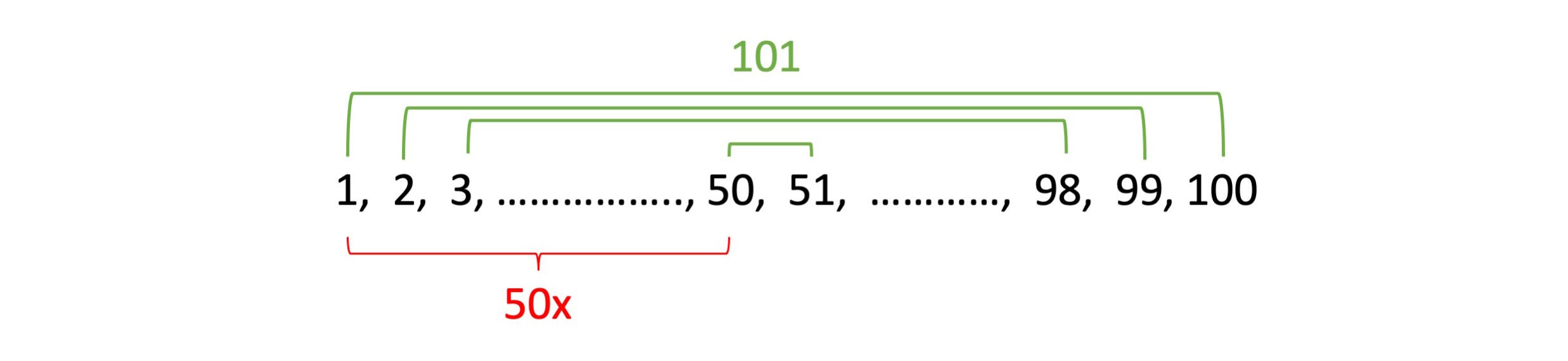
The teacher saw the boy’s talent and supported him. Carl Friedrich Gauss became one of the greatest mathematicians in history. The formula he discovered, (n+1) times (n/2), is called Gauss’s summation formula. This also shows how important a teacher can be for a person’s life path. Being a teacher is a very responsible task. I reflect on this in my article, “What Casanova Has to Do With the School System.”
The two examples illustrate a central aspect of mathematical activity: patterns. Therefore, the following also applies:
“Mathematics is the science of patterns.”
We mathematicians look for patterns – because they might help us answer a question, as was the case with the young Gauss, or simply so we can “play” with them.
A popular mathematical playground is the so-called natural numbers. These are the infinitely many numbers 1, 2, 3, 4, 5, …. Out of curiosity, we ask, for example: “Which numbers can be written as products of smaller numbers—except for the number 1?” The number 4 can be written as 2 × 2; 6 as 2 × 3; 8 as 2 × 4 or also as 2 × 2 × 2. This is not possible for 1, 2, 3, 5, and 7. So there are two types of numbers: those that can be factored and those that cannot. We call the latter prime numbers. Then we continue by asking questions like, “Is there a largest prime number?”
Even the ancient Greeks were interested in prime numbers, and so over the course of more tan 2,000 years, many of their properties have been discovered. Some findings influenced other areas of mathematics, such as algebra. Today, prime numbers play an important role in cryptography, ie the encryption of messages.
Patterns play a central role in many intelligence tests. That would be fine, but these tests are often used destructively. I explain how this happens in my article, “Many Intelligence Tests Are Not Only Nonsensical, But Downright Criminal.”
Numbers are abstract. While we can use them to count concrete objects, such as seats, that is not what mathematical play is about. We are simply curious about the properties of numbers and other abstract objects, the patterns they contain, and how patterns are related.
There are also patterns in reality; for example, an arrangement of seats, or the falling of objects. At first glance, the latter is a simple pattern: if I drop something, it falls downward. If we examine the falling process more closely, we realize: if something falls from a greater height, the impact upon landing is greater. This impact depends on speed – and it turns out that a falling object gets faster and faster.
The behavioral pattern of falling objects has already occupied thinkers of antiquity, such as Aristotle. At the beginning of the 17th century, Galileo Galilei was the first to describe free fall mathematically and correctly using a formula. At the end of the 17th century, Isaac Newton went a step further and formulated the law of gravity, which describes not only free fall but also the motion of the planets.
The law of gravity states: Two bodies attract each other; the force depends on the masses of the two bodies and their distance from one another. In fact, the falling stone also attracts the Earth, and the Earth moves toward the stone; however, because of its much greater mass, the Earth is vastly superior to the stone. Its movement toward the stone is so minimal that it cannot be measured.
It was a mathematical masterpiece of Newton to recognize the law of gravity as a common pattern in free fall and the motions of the planets.
We are dealing with two types of patterns:
patterns of abstract objects, such as numbers;
patterns of concrete objects, such as seats or falling objects.
This corresponds to the two major branches of mathematics: pure mathematics and applied mathematics.
Pure mathematics is a playing in which we invent the games ourselves. Metaphorically speaking, we choose a game board, game pieces, and rules, and then we start playing; as we do, for example, with prime numbers. Such a game has no purpose other than play itself.
„Play is the highest form of research.“
(Albert Einstein)
Mathematical play requires creativity and structured, logical thinking. Thinking is humanity’s superpower. I describe it in my article “That Is the Difference Between Humans and Animals.” Brain teasers train thinking. Games like tangram train thinking. The supreme discipline for training thinking is mathematics. Hence, it is also true that:
“Mathematics is thinking technology.”
Whether a mathematical game has anything to do with reality is of no interest to the pure mathematician. The American physicist and Nobel laureate Richard Feynman put it this way:
“In fact, the glory of mathematics is that we do not have to say what we are talking about. The glory is that the laws, the arguments, and the logic are independent of what ‘it’ is.”
(Richard Feynman)
Applied mathematics is about reality and solving real-world problems.
What is a problem? A problem exists when we want something based on something given. For example: Given a lecture hall; we want the number of seats. Or: Given a tower and a stone; we want the speed at which the stone hits the ground when dropped from the top of the tower. The wanted is called a solution to the problem.
The term problem is also used in pure mathematics, eg: Given the numbers from 1 to 100; we want their sum. Or: Given a natural number; we want its factorization into prime numbers.
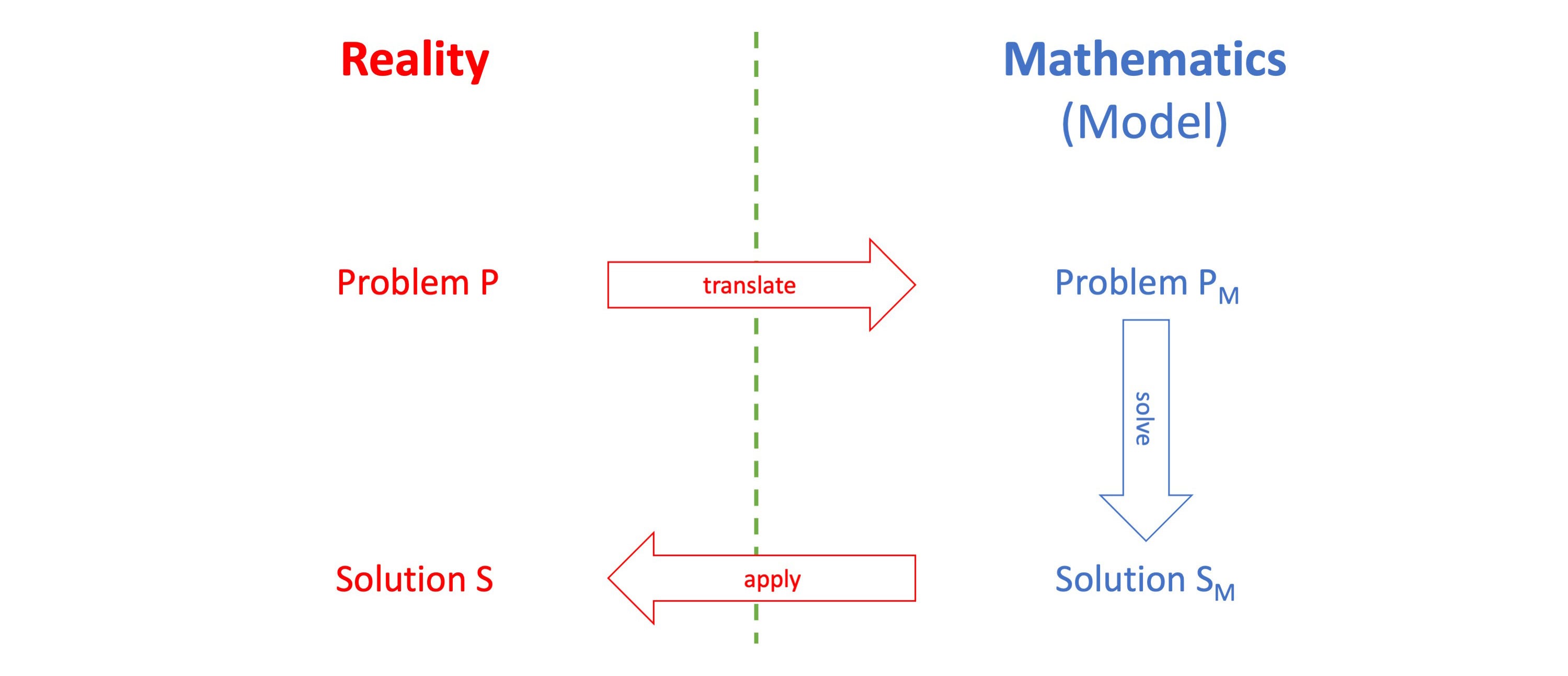
In applied mathematics, one proceeds as follows when solving a real-world problem: First, the real-world situation is modeled, ie described by a mathematical model or framework. For example, the motion of a falling stone could be described by a table that shows the remaining height above the ground at one-second intervals. The numbers would be obtained through observation.
The mathematical model simplifies the real-world situation. It describes only those properties that appear relevant to the solution. For example, the color of the stone is not modeled because experience shows it does not affect the fall.
Thus, in the first step, a real-world problem P is transformed into a mathematical model problem PM. In the second step, one attempts to solve the model problem PM using the tools of pure mathematics. If a model solution SM is found, one applies it to the real world in a third step … hoping to have found a solution S to the real problem. Whether this is the case must be verified experimentally.
The success of this method depends on two factors:
the quality of the translation of the real-world problem into a mathematical problem; and
the availability and quality of the tools of pure mathematics.
For the latter, one can draw on a wealth of resources. Over thousands of years, mathematicians have developed countless mathematical tools. Many arose playfully out of curiosity and only later proved useful.
One of the best-known mathematical tools is the Pythagorean theorem (“a squared plus b squared equals c squared”). It is useful because it helps construct a right angle. This theorem is much older than its namesake, who lived around 570–510 BC. The oldest known source for this theorem is the ancient Egyptian “Rhind Papyrus,” which dates back to 1,550 BC. This mathematical tool is already over 3,500 years old.
Applied mathematics has also often inspired pure mathematics. If you can’t find a suitable tool to solve a real-world problem, you can try to develop one… or you may have to create an entirely new mathematical game.
Today’s basic mathematical research is tomorrow’s technological progress because mathematics continuously produces new tools.
“Mathematics is problem-solving technology.”
But even the best mathematical tools are useless if the translation of the real-world problem P into a model problem PM is inadequate. This translation is not part of mathematics.
In mathematics, there is certainty. There, one can prove things; for example, that there are infinitely many prime numbers. Being able to prove this is remarkable because such a proof cannot be derived through calculation alone. The universe contains only finite resources and finite time; it is impossible to examine an infinite number of cases. Making the infinite manageable within the finite is one of the greatest achievements of pure mathematics.
“Insofar as mathematical propositions refer to reality, they are not certain; and insofar as they are certain, they do not refer to reality.”
(Albert Einstein)
Outside of mathematics, there are no proofs and there is no certainty. All other sciences are speculative. Statements like “Trust science” are utter nonsense. Scientific progress comes from questioning scientific findings. Doubt is the driving force behind science.
“If you thought science was certain – well, that’s a mistake on your part.”
(Richard Feynman)
If the mathematical solution SM is applied to reality and it turns out that S does not solve the real problem, this must be due to the translation of the problem P into the model problem PM. Then one must repeat the three-step process above … with a better translation.
Mathematics is everywhere. Today, more than ever. Virtually every technological progress is made possible by mathematical tools. The theory of relativity and quantum physics, for example, are two mathematical models that lie at the heart of our current understanding of physics and chemistry. Consequently, all resulting technology is based on mathematics. This includes not only space travel and lasers but also everyday technologies like GPS.
Artificial intelligence (AI) is also a form of applied mathematics. AI emerged from computer science, and computer science emerged from mathematics. The father of the computer is the English mathematician Charles Babbage. In the 19th century, he built the first working model of a calculating machine.
“Computer science is mathematics.”
“Artificial intelligence is mathematics.”
In my article “The Good, the Bad, and the Ugly of Artificial Intelligence,” I analyze AI systems and their significance for humanity. In my article “Why AI Systems Are NOT Intelligent,” I describe how they work and what mathematics is at their core.
“Mathematics is the engine of humanity’s intellectual and technological advancement.”
However, life comprises more than just intellect and technology. There are important aspects of our existence that are beyond the reach of thought. That is why we need non-thinking just as much as we need thinking. One of the great contemporary mathematicians, Bruno Buchberger, reflects on this in his highly recommended German language book “Wissenschaft und Meditation – Auf dem Weg zur bewussten Naturgesellschaft“ (“Science and Meditation – Toward a Conscious Society in Harmony with Nature”).
*
Further readings:
Article “What Casanova Has to Do With the School System”
Article “Many Intelligence Tests Are Not Only Nonsensical, But Downright Criminal”
Article “That Is the Difference Between Humans and Animals”
Article “The Good, the Bad, and the Ugly of Artificial Intelligence”
Article “Why AI Systems Are NOT Intelligent”
Book „Bruno Buchberger: Wissenschaft und Meditation – Auf dem Weg zur bewussten Naturgesellschaft“ (“Science and Meditation – Toward a Conscious Society in Harmony with Nature”)
"With 8 seats per row and 12 rows, that’s 8 times 12, which gives 108."
Given that 8 x 12 is 96, was that an intentionally sly attempt at humor?